|
|
 |

Explore: Solar and battery development. Battery Grids and investments and holiday homes. Rebates and Commercial Grids and factories. Linking the grid with the Commonwealth as an investor.
Solar Programs & Grid Expansion
Expansion and development of the Solar Industry and “switching on” the whole grid to develop in a sustainable and rational way is also a significant challenge.
Though governments have been providing some rebates and the industry is growing, through the ‘Enviro’ tax I would expand these programs and even go as far as encouraging the Commonwealth to take over their management and add some additional programs that can expand as we move forward in transition. I think it is time to move forward from a “piece-meal” approach and state based programs to ramp it up under programs that may subsidise the Industry with assistance of at least $1.5 billion annually.
I consider the federal government is well placed to meet business in the middle, and provide the infrastructure for solar and larger grid storage to consolidate the “middle” ground of energy and power. By building larger solar infrastructure through federal funding it can then link the grid together to build a substantial network of solar charging through urban and industrial areas. This can only assist in the development of creating a sustainable and efficient grid network which can also back-up car charging and reduce electricity costs overall in the future. Though the federal government has made commitments to larger infrastructure like Snowy 2 and other Hydro and smaller projects, a comprehensive and overarching strategy could create a more cohesive energy grid.
https://www.energy.gov.au/government-priorities/energy-programs/energy-efficient-communities-program
The ‘Community Grid’ concept is a path that is only now taking hold in Australia. In a rational transition the community grid can reduce costs to towns, industries and suburbs to a “lever” point of value, efficiency, and sustainability. The WA government is now funding small community grids (at 3/2021) in an experimental grid program. Grids are now possible with the VPP concept of Virtual Power Plant. Though the Commonwealth is funding some businesses and community groups to save on power bills, the community grid concept is far from complete. The ‘Energy Efficient Communities Program. This first commenced in late 2020. The scale, at date, is small with a limited grant model to community organisations and businesses (turnover under $10 Million). 2020 business grants funded nearly 1000 businesses with approximately $40 Million. In 2020 approximately 250 Community organisations receive grants of $12,500 each. Not all of this funding was to upgrade to battery technology. (VPP was not advised).
The inventive step is to take funding to the next level and “pump up” the funding for VPP and small batteries with ‘Poles and Wire’ funding to further balance the grid and work with a fiscal model to build it, and yet, allow it to pay for itself. If the Commonwealth fully funded “Community” grid across the country the next level of solar for the community would include grids for suburbs and nursing home complexes, commercial centres and schools. Perhaps some of this grid complex would work on an individual group model at a particular cost service ratio for each community grid. Then each community or commercial grid can on-sell their extra energy through VPP and its associated technology. Current VPP programs now operating suggest a retention of 20% of their power for their own supply.
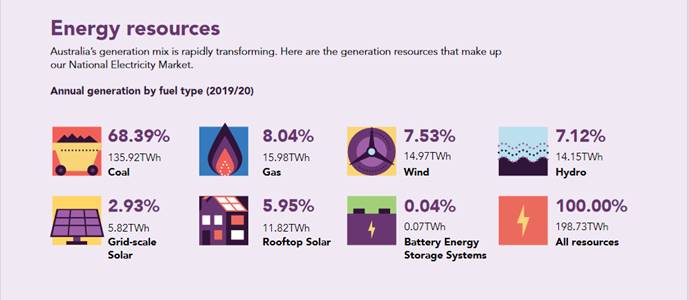
The chart below shows the current generation of electricity supply at 28/7/2020. This chart reflects all sources of power generation for the east coast market (Not WA or the NT).
© Copyright AEMO
https://aemo.com.au/-/media/files/electricity/nem/national-electricity-market-fact-sheet.pdf
At this date, Coal generation still sits at 68% for the east coast grid and rooftop solar still sits at 5.95% generation. Gas is at 8%. And so the scope at 2021 to build solar even further at a community level is substantial. And though it is fair to say that the solar power industry is at a “mature” stage of development the application and the funding to model to the next level is not currently present (at 2021). To transition energy effectively and to reduce costs the community grid has still plenty of potential to grow. Community power generation and ownership is the next level of growth which can reduce emissions in the future. Gas as back-up generation and hydrogen power generation as next technology is rational beyond 2030. A fully developed solar generation program needs to aim to the “middle” of the economy. I see the Commonwealth as the source of back-up generation like SMA-Snowy Mountains Authority. Established power companies can build grid power effectively though if the Commonwealth or the States fully backed domestic solar with VPP technology and sectors like Aged care, education (including universities), and commercial zones under a suitable funding model then the solar industry can be more independent and self-reliant.
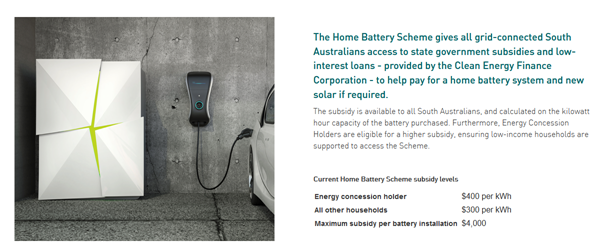
The Hornsdale Tesla battery in SA was funded with $50Million through the CEFC. And certainly, if the Commonwealth stepped in or the States funded the community grid to the next level (by the CEFC or other) then electricity generation by solar and its associated technology could build to a level between 30-50 percent of the market. (my estimate). The cost of power generation would shift depending on the supply in the market (as you would expect). More power on demand and available means less cost. It might help significantly if the Commonwealth committed funding to “firm” the grid for the long term. It depends on the commitment to the community and the market through government and to some extent business.
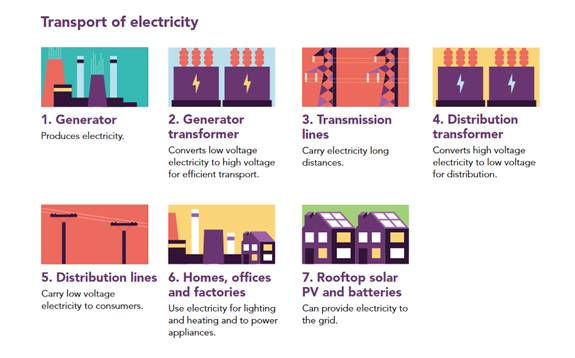
A suburban, or suburb-by suburb, concept is not beyond the current scope of technology and development. Even the Solar carpark concept has substantial impact across Australia as VPP technology. Though rooftop solar is stated at 25% in some parts of the east coast this does not include a VPP-Virtual Power Plant concept and there is still an issue of the stability of the grid with extra surges from direct feed-in. A VPP power concept has the potential to adjust load fluctuation and is the inventive step. It just requires funding to embrace the “middle ground” of electricity generation in Australia. VPP has only just begun but its expansion has huge potential.
https://www.solarquotes.com.au/battery-storage/vpp-comparison/
A Commonwealth owned power company may be a strategic direction to build and stabilise the grid. If the Commonwealth invests in the asset base of power generation (like the Snowy Mountains Authority) there is the potential to influence the process of grid stabilisation and even reduce the cost of power further. Like any other asset it could be sold off in 2050 if it has fulfilled its role.
A new federally funded power company may be practical and useful in transition. The ‘Commonwealth Power Corporation’. Enough money was provided for COVId19 to easily do this. A vision to commit to stabilise the National Energy Market and increase value to consumers holds to a high social principle for greater return. ‘Feed-In’ Tariffs are currently managed by the State governments and provided by different energy retailers. A Solar Tariff funded or set by the Commonwealth may assist the market in the future.
© Copyright AEMO
https://aemo.com.au/-/media/files/electricity/nem/national-electricity-market-fact-sheet.pdf
Discussing the production of hydrogen (in 2021), Alan Finkel, Australia’s former Chief Scientist, has advised that the development of the Hydrogen export market will use 8 times Australia’s current annual output of electricity generation.(Nb: for 33Million Tonnes of Hydrogen). This energy output is 75 times more than current solar power output. These are huge numbers. Ref: Dr Alan Finkel: https://www.quarterlyessay.com.au/essay/2021/03/getting-to-zero Pg.66
The expansion of the Virtual Power Plant concept in the domestic and commercial sectors seems realistic and rational to support and build capacity across the grid to support industry and to build and conceive the Hydrogen industry. Linking and further developing the Solar Renewable Zones in NSW is another way that the Commonwealth can assist to build grid capacity. Even these projects are possible under the $500 Million Plus funding model advised as big infrastructure projects. To link these local solar farms to a power grid has substantial merit as an infrastructure project. At this date, it only requires the Commonwealth to intervene.
https://www.industry.gov.au/regulations-and-standards/major-projects
https://energy.nsw.gov.au/renewables/renewable-energy-zones
Gas-fired Power generation certainly seems like a medium term (5-20 years) transition from coal, though Hydrogen would be the ultimate goal. Nuclear generation may not be required if enough investment is made. In 2021, a transition to hydrogen has a long way to go. As indicated in the chart above even a target of 50% solar with battery seems like a massive step without the financial commitment and the motivation. Commonwealth intervention, with the States, to “firm” or stabilise the grid and the energy market may be a requirement, and this may also require $Billion funding and investment. This is also a high-value investment. Building hydrogen power generation beyond that and beyond 2030 is a significant step. Also it is significant to mention as Precipitable Water Vapour(PWV) is THE major greenhouse gas a clear pathway to manage water cooling as a by-product from Hydrogen power will need to be implemented.
Further Commonwealth intervention and, also, State government intervention seems a rational step to evolve the national energy market. It may even be essential and vital.
A range of programs are possible
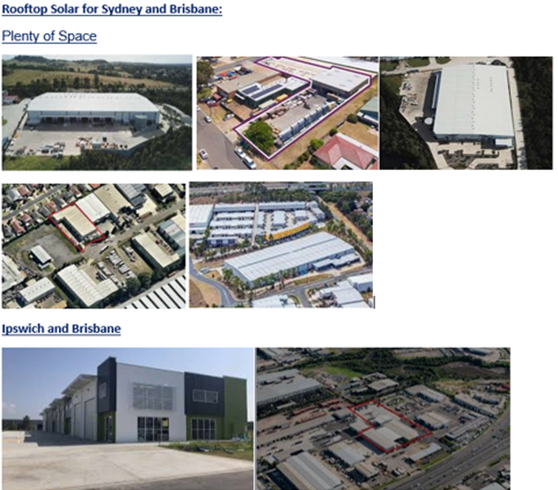
- Urban Solar Grid program. Using factory roofs for solar and linking to the grid. (5) Considerable opportunities to develop this in factory areas of urban centres. Likely even charging stations can be built near Commercial areas and shopping centres are ideal for re-charge stations.
- Extensions of grid programs to country areas and coastal areas where there are significant semi- occupied holiday homes. (5-10) Funded partially by the government to fit Battery solar to the grid so power can be sold back to power providers to feed the grid system. Designed to return dividends to owners and power suppliers. (With a Link to the Age Pension). Federal government Installs with 60-40 Split with owners re: Installation. Federal Government Owns power 60-40 with owners and sells back to the State Grid.
- Battery technology is now able to create ‘Virtual Power Plants’(VPP) in the home market and with smart technology can supply on-demand power to the grid as required from suitable solar batteries. With built-in monitoring this technology can really help build the grid. If the grid can be built to support those low-income earners or tenants paying rent this could only improve the lifestyles and savings of those most in need. Government funding right now could make a substantial difference for many in the community.
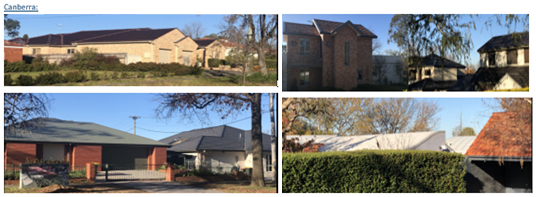
- Within the domestic sector homes may be assessed on their merit and new homes constructed to build in Solar Battery charging. (As per the new homes here shown). A priority of any build or property construction is to ensure that the property has the capacity to run Solar Battery. The government could possibly subsidise new owners with a Solar grant for any build ($12-25k) and possibly apply an extra infrastructure for those preferring to stay on the main grid($25K or linked to income through the ATO).
- Ensure that rural communities switch to solar battery programs with clean diesel back-up as required. Encouraging as many rural communities to get off the grid as much as possible.
- Possible Solar bond linked to the Age Pension. (5) Depending on the rate of Age Pension pensioners can be partially subsidised to install battery power on their property. A Commonwealth mortgage (Caveat) will be held over the property for sale or repayments at a later date.
- A priority of the Solar CCF program may be the introduction of an Entry Bond and an Exit Bond to be applied for those overseas investors wishing to purchase property in Australia. The Entry Bond is used to set up Solar Battery in suitable homes at purchase. Exit Bond legislation could be established now through legislation by the States to request an Exit Bond be paid at the time of sale to be paid to the Commonwealth to install Solar Battery.
- Any individual or company from overseas purchasing a Unit or smaller property, part of the Enviro Tax package may obligate them to also pay a small Bond to assist in ‘Grid Building’.
- If Individuals dislike the concept of a Bond and Solar Battery switch and their home is considered suitable then an indexed “Infrastructure penalty” can be applied that matches the power usage for the property and could be linked annually to the income of the owner. Possibly Australian citizens who are unit owners can be exempt or pay a reduced Bond
Some of these programs may be linked to the ATO to identify specific
consumers. And for some Age Pensioners possibly they can be granted
extended principal home exemptions for nursing home care for a longer period.
A possible exemption that could be applied for 3-4 years may be fair for those who adopt Battery/Solar rather than the two-year exemption currently in place for those going into nursing homes.
Summary
- The Priority of the ‘Enviro Solar Grid’ program is to build the grid on several levels.
- To maximise the opportunities for all home and cities to be self-sustainable as possible.
- To maximise the opportunities to bring income in for government by taxation and apply levers to make it happen.
- The Commonwealth becomes a “player” in the market so it can on-sell power to the States and companies. This ensures that the grid is fully switched and worked to capacity for better management in the future.
- The building of a ‘Life-Event’ scenario into these programs can create on-going certainty for the future and a smoother transition.
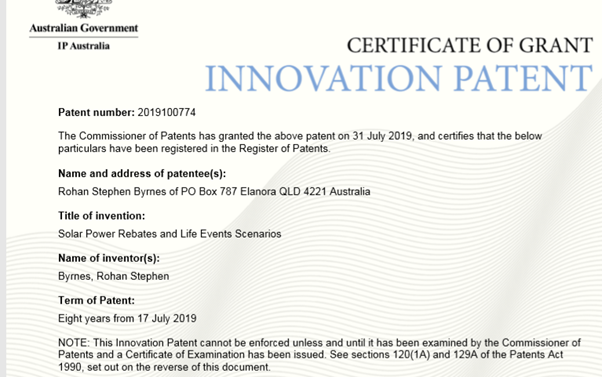
Below is an Innovation Patent that I was granted in July 2019.
Solar Power Rebates and Life Events Scenarios
The installation and use of solar panels and associated technology, including off-grid battery storage and associated systems of technology linked into the life cycle concept of ‘Life Events’ administered by, or previously administered by, Human Services, or any other government department in Australia. This patent includes all Commonwealth or State or Local government or other agencies or institutions currently in existence at present or in the future. This patent applies in respect to rebates within Australia in respect of application of fees and charges and or rebates and incentives in any form based on, or linked to, benefits and allowances and pensions provided by The Department of Social Security, or any other payments provided by any Commonwealth department directly involved in, or applying, the ‘Life Event’ concept or any other ‘Life Event’ scenario as indicated through the included attachments. This delivery of solar rebates or services are specifically linked to the innovation of using the ‘Life Event’ concept with any Commonwealth, State or Local Government department or institution or agency and includes any application or process that applies those fees and charges and or rebates and incentives to any commercial or private enterprise, business or individual.
https://homebatteryscheme.sa.gov.au/about-the-scheme